

Euro area  decreased to €809 billion in four quarters up to first quarter of 2022, compared with €824 billion in 2021.
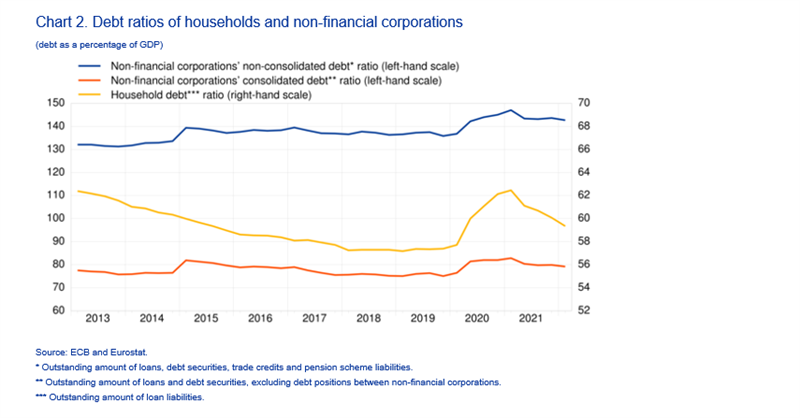
±á´Ç³Ü²õ±ð³ó´Ç±ô»åÌý declined to 96.2% in first quarter of 2022 from 96.5% one year earlier.
Non-financial corporations’Â Â (consolidated measure) decreased to 78.8% in first quarter of 2022 from 82.5% one year earlier.
Total euro area economy
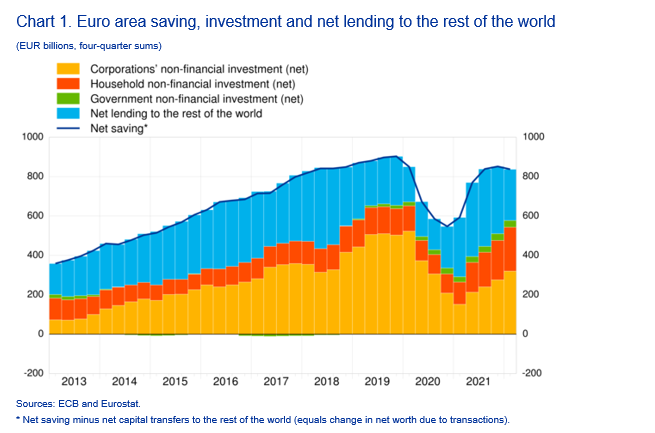
Euro area  decreased to €809 billion (8.0% of euro area net disposable income) in the four quarters to the first quarter of 2022 as compared with €824 billion in the four quarters to the previous quarter. Euro area  increased to €577 billion (5.7% of net disposable income), due to increased investment by households and non-financial corporations, while net investment by financial corporations and by government were broadly stable (see Chart 1).
Euro area  to the rest of the world decreased to €260 billion (from €342 billion in the previous quarter) reflecting the decreased net saving and increased net non-financial investment. Net lending by households declined to €440 billion (4.4% of net disposable income, after 5.9% previously). Net lending of non-financial corporations declined to €237 billion (2.4% of net disposable income, after 3.0%) and that of financial corporations decreased to €73 billion (0.7% of net disposable income, after 0.9%). The decrease in net lending by the total private sector more than offset a decrease in net borrowing by the government sector (-4.9% of net disposable income, after -6.3% previously).
Households
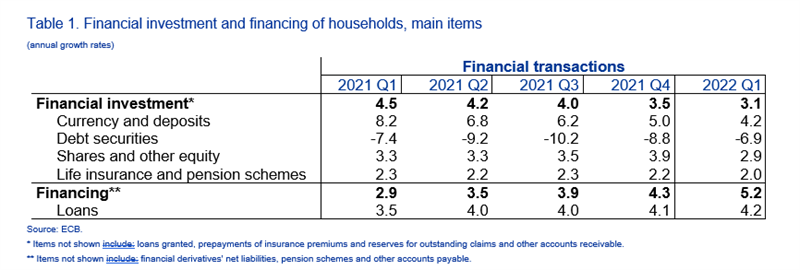
±á´Ç³Ü²õ±ð³ó´Ç±ô»åÌý increased at an annual rate of 3.1% in the first quarter of 2022, down from 3.5% in the previous quarter. This deceleration was mainly due to lower growth rates of investment in currency and deposits (4.2%, after 5.0%), shares and other equity (2.9% after 3.9%), and life insurance and pension schemes (2.0% after 2.2%) (see Table 1 below).
Households were overall net buyers of listed shares. By issuing sector, they were net buyers of listed shares of non-financial-corporations, insurance corporations and the rest of the world (i.e. shares issued by non-residents of the euro area), while shares of MFIs and other financial institutions were sold, in net terms. Households continued to sell debt securities (in net terms) issued by MFIs, other financial institutions, government and the rest of the world, while debt securities issued by insurance corporations were bought on a net basis (see Table 2.2. in the Annex).
The household  decreased to 96.2% in the first quarter of 2022 from 96.5% in the first quarter of 2021. The household  decreased to 59.3% in the first quarter of 2022 from 62.5% in the first quarter of 2021 (see Chart 2).
Non-financial corporations
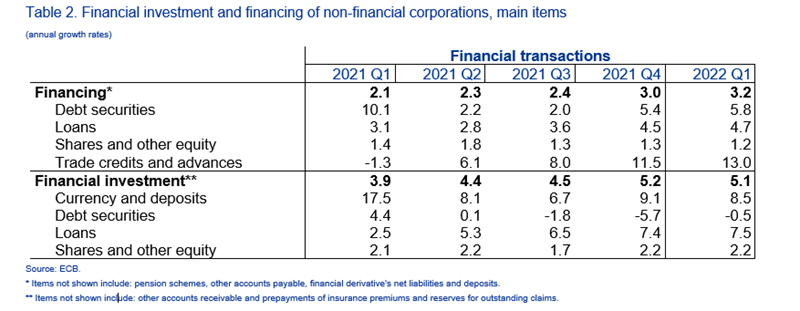
°Õ³ó±ðÌý of non-financial corporations increased at a higher annual growth rate of 3.2% in the first quarter of 2022, after 3.0% in the previous quarter, following an acceleration in financing by trade credits, loans and debt securities (see Table 2 below). The acceleration of loan financing was due to loans from the rest of the world and from non-MFI financial corporations increasing at higher rates, which more than offset a deceleration of financing via loans from MFIs, intercompany loans and loans from government (see Table 3.2 in the Annex).
Non-financial corporations’  (consolidated measure) decreased to 78.8% in the first quarter of 2022, from 82.5% in the first quarter of 2021; the , wider debt measure decreased to 142.7% from 147.1% (see Chart 2).
ecb.europa.eu


